Aag ka Darya
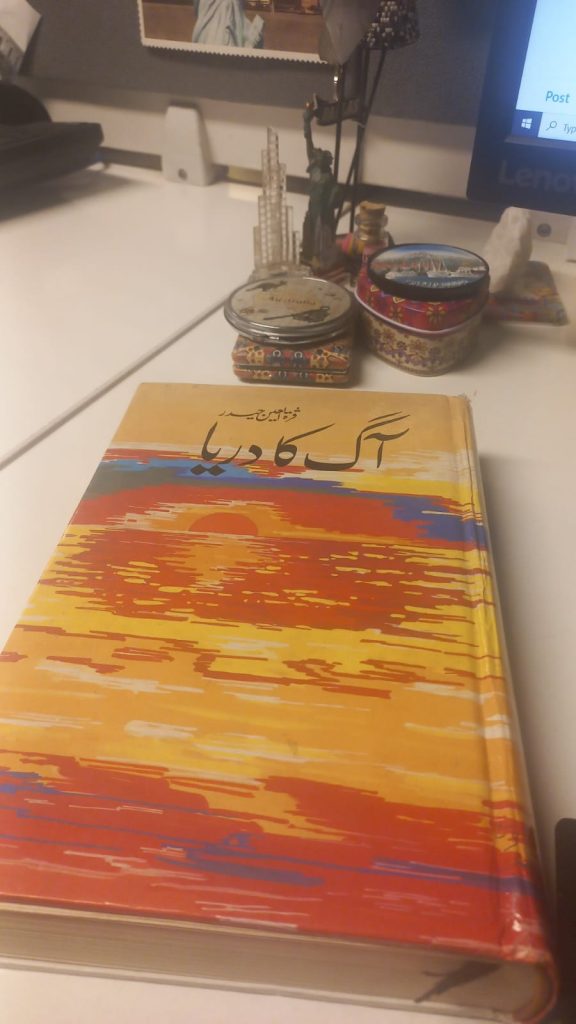
This Eid turned out to be truly wonderful. Not just one or two, but with the completion of the entire thirty days of Ramadan, I was fortunate to enjoy four consecutive holidays. Perhaps after a long time, I got the opportunity to truly make the most of such an extended break.
One of the most fulfilling aspects of these days was reconnecting with books, getting my hands on some new ones and revisiting a few old reads. At the top of that list was Aag Ka Darya.
I had read this novel years ago, but only superficially, more out of compulsion and perhaps to impress friends, never truly grasping its spirit. Aag Ka Darya, a masterpiece by Qurratulain Hyder, not only challenged the form, technique, and style of the Urdu novel but also gave it an entirely new dimension.
This time, I picked it up not just to read, but to feel it. The novel begins with a poem by T. S. Eliot, where time is symbolized as a river, capturing the anguish of those carried along by its flow. Though only two pages long, this poem seems to encapsulate the essence of the entire novel.
The novel is often considered a pinnacle of philosophy, history, and intellect in literature. It does not rely on a conventional plot, nor does it center around a single dominant character. If anything binds the narrative together, it is time itself, portrayed as a flowing river.
Spanning nearly two and a half thousand years across four distinct eras, the story presents four characters who seem like different manifestations of the same existence, drifting through the river of time. This flow does not separate them; rather, it deepens the realization that borders may shift, eras may change, and religions may evolve, but the essence of identity remains constant. Each form is incomplete without the other.
In many ways, the novel can also be seen as a response to the question of identity. It challenges divisions and emphasizes staying connected to one’s roots. It is a river in search of the true meaning of freedom.
From a literary perspective, the novel employs the technique of stream of consciousness, where human thought is presented as fluid and continuous. Ideas emerge one after another like scenes unfolding on a screen, giving more importance to inner emotions and psychological states than to external action.
The narrative weaves together past, present, and future, telling a story that stretches from ancient times to the Partition of India.
This was Qurratulain Hyder’s third novel, written between 1956 and ’57 and published in 1959, roughly a decade after Partition. According to one account, the inspiration behind the novel came from a simple question about Basant, asked by a young cousin. That innocent curiosity led her to reflect deeply on cultural continuity and identity, eventually giving birth to this remarkable work.
Lastly, I am deeply grateful for these precious Eid holidays and especially to my dear sister, Zainab Apa, who generously lent me her treasured copy of the novel, one that had been passed down to her by her grandfather. Through her, I was able to experience this profound and beautiful journey.